Garage Door Maintenance Checklist: Tracks, Rollers, Hinges, and Hardware
A garage door is easy to ignore when it works. It goes up, it comes down, and most days that is all anyone asks of it. The trouble is that a residential garage door is also one of the largest moving systems in a home. It has weight, tension, electrical controls, pinch points, and hardware that repeats the same motion hundreds or thousands of times a year.
Good garage door maintenance is not about polishing every part until it looks new. It is about noticing small changes before they become hard failures. A roller that drags today can strain a hinge tomorrow. A loose bracket can throw off a track. A door that feels heavy by hand can wear out a garage door opener that was never meant to lift the full weight of the door. The opener guides and controls the door, but the spring system carries the load.
The most useful maintenance habit is a calm, regular garage door inspection. You do not need to dismantle the door. In fact, you should not. Springs, cables, bottom brackets, and any part under high tension deserve respect and, in many cases, professional service. But a homeowner can still do a great deal: listen, look, clean, tighten appropriate hardware, lubricate the right points, and stop using the door when something is clearly wrong.
Start with safety before touching anything
Before looking at tracks, rollers, hinges, and hardware, treat the door as a moving mechanical system, not a household appliance. Keep children away from the door, the wall button, remote controls, and any moving parts. Keep people clear while the door is operating. If you are inspecting the door, let everyone in the house know not to press the opener.
Modern automatic garage door systems should include entrapment-protection features such as photoelectric garage door sensors. Automatic residential openers manufactured on or after January 1, 1993 were subject to revised safety requirements intended to reduce entrapment hazards. Older non-reversing openers are a serious safety concern, and a door system without proper reversal protection should not be treated as acceptable just because it still runs.
Safety also means knowing when to stop. If the door is jammed, hanging crooked, has a broken spring, or has a loose or damaged cable, do not keep pressing the opener button to “see if it clears.” That habit is responsible for a lot of avoidable garage door repair. A stuck door can bend tracks, damage panels, pull hardware loose, or strain the opener. Broken garage door springs and compromised garage door cables are high-risk issues. Leave spring work, cable replacement, and major tension adjustments to a qualified technician.
The balance test tells you more than the opener does
Many homeowners judge the condition of the door by how the garage door opener sounds. That can be misleading. A strong opener may drag a poorly balanced door along for a while, hiding the real problem until rollers, hinges, brackets, or the opener itself begin to suffer.
A better first check is garage door balance. With the door closed, disconnect the opener using the manual release according to the owner’s manual. Then lift the door by hand. A properly balanced door should move smoothly without feeling like dead weight. If it will not move smoothly by hand, the spring system may be out of balance. That imbalance can accelerate wear on garage door rollers, hinges, and other hardware because every cycle adds extra strain.
Do not use an opener on an improperly balanced door. The opener is not a substitute for a correctly adjusted spring system. If the door feels unusually heavy, drops quickly, rises on its own, binds, or refuses to stay where expected, reconnecting the opener and forcing operation is the wrong move. That is the time for professional garage door troubleshooting.
There is also a practical reason to start with balance. If a door is badly out of balance, maintenance on the rollers and hinges may make it quieter for a short time, but it will not solve the underlying issue. The door may still rack, bind, and chew through hardware. Balance comes first because everything else depends on it.
A practical maintenance rhythm
Most residential doors benefit from periodic inspection and light maintenance. The exact frequency depends on use, climate, door age, and exposure to dust or moisture. A garage door on a busy household, especially one used as the main entrance, deserves more attention than a door that opens a few times a week.
Use this short checklist as a practical rhythm, not as a substitute for the owner’s manual or professional service when something is wrong.
That is the core of garage door maintenance. It is simple, but it catches many problems early. A new squeak, a roller that no longer turns, a hinge crack, or a bolt backing out can often be seen before the door fails. The key is to inspect while the door still works, not after it has already jammed halfway open on a rainy morning.
Tracks: clean, aligned, and free of impact damage
Garage door tracks guide the rollers and keep the door moving in the correct path. They are not supposed to carry the door’s full weight, and they are not supposed to be coated in grease. A clean track allows the rollers to move without collecting grit. A greasy track becomes a dirt trap, especially in garages where sawdust, leaves, road grit, or storage dust are common.
During a garage door inspection, look along both vertical tracks and the horizontal sections overhead. You are looking for debris, dents, bends, loose fasteners, and spots where the rollers seem to rub hard against one side. A small amount of ordinary wear is expected. A track that has been hit by a car bumper, ladder, trash bin, or stored item may show a flattened edge or inward bend. Even a modest bend can make the door shudder or bind.
Cleaning the tracks is usually straightforward. Wipe out visible dirt and debris with a cloth. If the tracks are sticky from old lubricant, clean them enough that rollers can move without grinding through residue. Do not add garage door lubrication to the tracks afterward. Lubricate the moving parts that need it, not the runway they travel through.
If a track appears badly bent, pulled away from the wall, or misaligned enough that the door binds, treat it as a repair issue rather than a maintenance chore. Tracks work as part of a system. Bending one back casually with pliers can create a new problem if the door no longer travels evenly. This is especially true when the door is already crooked or under strain.
Rollers: small parts that change the whole feel of the door
Garage door rollers have an outsized effect on noise, smoothness, and wear. When rollers are in good condition, the door moves with less chatter. When they are worn, seized, cracked, or loose in the stem, the door may shake, squeal, or drag through the tracks.
Different roller materials behave differently. Nylon rollers are often chosen for quieter operation. They also require judgment during maintenance because some manufacturer guidance specifically advises not to lubricate nylon rollers. Metal rollers, by contrast, may benefit from appropriate lubrication at the bearing area if the roller design allows it. The safest approach is to follow the door and roller manufacturer’s instructions. If you do not know what type you have, inspect carefully before spraying anything.
One common mistake is using lubricant as a cure for a bad roller. Lubrication can quiet a dry bearing or hinge, but it will not restore a roller that is cracked, flat-spotted, wobbling badly, or no longer turning. A roller that slides instead of rolls can wear the track and make the opener work affordable garage door installation Gold Coast harder. If several rollers look worn, garage door replacement of those rollers may be more sensible than repeated lubrication.
Roller replacement also has a safety boundary. Some rollers are located near brackets and cable attachment points under significant tension. Do not loosen bottom brackets or cable-related hardware. If roller access requires disturbing high-tension components, call for garage door repair. The cost of doing that work safely is far easier to accept than the consequences of releasing stored spring tension by mistake.
Hinges: the door’s folding joints
Sectional garage doors rely on hinges to let the panels bend as the door travels from vertical to horizontal. Those hinges handle repeated movement, panel weight, vibration, and the small alignment changes that happen during every cycle. When hinges wear or loosen, the door can clatter, sag between sections, or move unevenly.
Look at each hinge with the door closed and again from a safe position as the door moves. You are looking for cracks, missing screws, elongated screw holes, bent leaves, and metal dust around pivot points. A cracked hinge should not be ignored. The failure of one hinge increases stress on neighboring hinges and may allow a panel to flex in a way it was not designed to flex.
Tightening hinge screws is one of the more accessible homeowner maintenance tasks, provided the screws are reachable and not associated with high-tension hardware. Use a properly fitting tool and avoid stripping the fastener. If a screw spins without tightening, the underlying material may be damaged. Simply driving in a larger screw without understanding the door construction can create a weak repair. In that case, a professional can determine whether the hinge, fasteners, or panel needs attention.
For garage door lubrication, hinges are usually one of the key points. A silicone-based lubricant or white lithium grease is commonly recommended for appropriate moving parts, including hinges, rollers, springs, and bearing plates when directed. Apply sparingly. The goal is a thin film at the moving joint, not a dripping mess that attracts dirt. Wipe off excess after application.
Hardware: the bolts and brackets that quietly hold the system together
Garage doors vibrate. Every open and close cycle creates movement through the hinges, brackets, track supports, opener arm, and fasteners. Over time, some hardware can loosen. This is especially common on older doors, frequently used doors, and doors that have been operating out of balance.
During inspection, scan for missing bolts, loose nuts, shifted brackets, and fasteners backing out of hinges or track supports. Light tightening of accessible, non-tension hardware is reasonable for many homeowners. The important word is accessible. Do not loosen or adjust parts tied to springs, cables, bottom brackets, or torsion hardware.
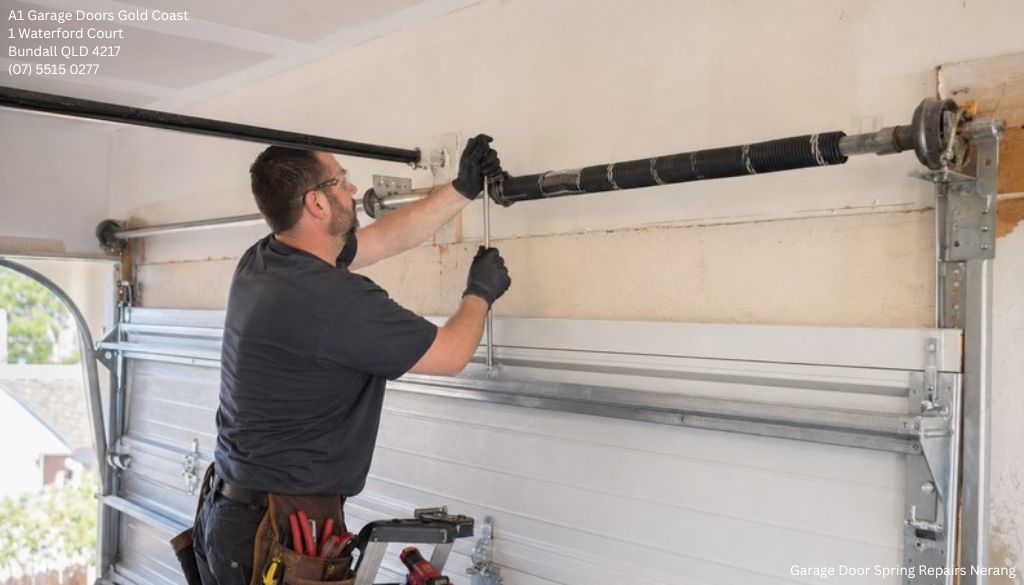
Torsion springs are mounted above the door on many systems and store significant energy. Extension spring systems, where present, also carry risk. Garage door springs are not ordinary hardware, and spring adjustment is not a casual do-it-yourself task. The same caution applies to garage door cables. Cables may look simple, but they are part of the lifting system. A frayed, loose, or displaced cable is a stop sign.
Hardware problems often show up as symptoms elsewhere. A loose track bracket may cause roller noise. A worn hinge may make the opener jerk. A missing fastener may let a panel shift enough that the door appears to have a track problem. Good garage door troubleshooting means tracing the noise or movement back to the part causing it, not just treating the loudest symptom.
Springs, cables, and the line between maintenance and repair
A homeowner can inspect garage door springs and cables visually, but inspection is not the same as adjustment. Look for obvious signs of trouble from a safe distance: a visible gap in a torsion spring, a cable hanging loose, a cable off its drum, fraying, or a door that sits crooked. If any garage door sources of those signs appear, stop using the door and arrange professional service.
Broken springs are one of the clearest examples of why the opener should not be forced to compensate. A door with a broken spring may be extremely heavy. The opener may hum, strain, lift a few inches, or fail completely. Continuing to press the button can damage the opener and hardware. It can also create a more dangerous situation if the door moves unpredictably.
Spring systems also affect the lifespan of everything else. When springs are properly balanced, rollers roll, hinges pivot, and tracks guide. When springs are out of balance, those same parts become load-bearing in ways they should not. That is why a smooth manual lift test is not a minor detail. It is central to garage door safety and long-term performance.
Lubrication: where it helps and where it causes trouble
Lubrication is one of the most misunderstood parts of garage door maintenance. People often spray the loudest area, then keep spraying until the noise changes. That approach can hide a problem and create new mess.
Use a silicone-based lubricant or white lithium grease where recommended by the manufacturer. Common lubrication points include hinges, appropriate rollers, springs, and bearing plates. Apply modestly and wipe away excess. Excess lubricant attracts dirt, and dirt becomes grinding compound. More product does not mean more protection.
Do not lubricate the tracks. Tracks should be clean, not slick. The rollers need to roll through them, not skate through a coating of grease. Also be cautious with nylon rollers. Some guidance specifically says not to lubricate nylon rollers, and high-quality nylon rollers are often used for quieter operation without needing the same treatment as metal components.
If lubrication does not solve a squeal, scrape, or shudder, do not keep applying more. Noise may be caused by a worn roller, cracked hinge, loose bracket, damaged track, improper balance, or opener issue. Lubrication is maintenance, not diagnosis by itself.
Opener behavior: what it can and cannot tell you
The garage door opener is part of the system, but it is not the whole system. Opener problems sometimes begin as door problems. If the door binds, drags, or feels heavy by hand, the opener may reverse, stop, strain, or make unusual noises. Before assuming the motor is failing, check the door’s manual movement and balance.
Garage door opener safety deserves special attention. Consult the owner’s manual for testing and maintenance specific to the unit. Keep children away from controls. Make sure the door area is clear before operation. Photoelectric garage door sensors should be aligned, clean, and unobstructed. If a door will not close and reverses repeatedly, dirty or misaligned sensors may be involved, but so may a mechanical obstruction or binding door.
Older openers without modern reversing protection are a safety concern. If you have an older system that does not reverse properly or lacks expected entrapment-protection features, consider replacement. Garage door replacement often refers to the door itself, but opener replacement can be just as important when safety systems are outdated or unreliable.
Smart open-close technology has made garage access more convenient, but it does not replace mechanical maintenance. A phone alert can tell you the door was left open. It cannot tell you that a hinge is cracking unless someone inspects it. Treat connected features as a convenience layer, not as a substitute for looking at the door.
Noise reduction without chasing the wrong fix
A noisy garage door is not always unsafe, but noise is useful information. The type of sound matters. A dry squeak often points toward hinges or metal roller bearings. A rumble may come from rollers. A scrape may suggest track contact. A bang or sudden pop deserves more caution, especially if the door changes how it moves afterward.
Quieting a door usually starts with inspection, cleaning, tightening, and appropriate lubrication. Nylon rollers may reduce operating noise when replacement is appropriate. Loose hinges and track brackets can amplify vibration. A balanced door also tends to sound better because the hardware is not fighting extra load.
There are limits. A door with damaged panels, poor balance, a failing spring system, or bent tracks will not become a healthy door because it received lubricant. If the noise is paired with jerky movement, crooked travel, reversing, or difficulty moving by hand, shift from maintenance to diagnosis. That is where professional garage door repair is often the safer and cheaper choice.
Panel damage and why it affects hardware
Panel damage can look cosmetic, especially if it is a dent from a basketball, trash bin, or light vehicle contact. Sometimes it is cosmetic. Other times, the damaged section changes how the door flexes. Sectional doors rely on panels, hinges, rollers, and tracks working together. If a panel bows or cracks near a hinge location, that hinge may no longer sit square. The roller attached to that area may then enter the track at a slight angle, creating noise and wear.
Minor-looking damage near hardware deserves a closer look. If screws are pulling out, hinges are twisting, or the panel skin is separating around a bracket, the door may need panel repair or replacement. When multiple sections are damaged, or when the door is old and hardware is worn throughout, full garage door replacement may be more practical than piecemeal work.
This is also where garage door installation quality matters. A properly installed door has tracks, hardware, opener connection, and spring balance set up as a system. DIY garage door installation is possible for skilled homeowners who carefully follow instructions, but spring installation and adjustment are especially hazardous. A door that starts life poorly installed tends to keep producing maintenance problems.
When maintenance becomes a service call
The value of a checklist is not that it turns every homeowner into a technician. Its value is helping you recognize normal upkeep versus risk. Cleaning tracks, listening to the door, inspecting hardware, and applying the right lubricant are maintenance tasks. Adjusting springs, replacing cables, correcting serious track misalignment, and operating a jammed door are not routine homeowner chores.
Call for professional help when you see any of these conditions:
Those are not scare tactics. They are the practical boundaries that separate useful maintenance from unnecessary risk. A garage door has stored energy and moving weight. Respecting that boundary protects people, vehicles, tools, pets, and the door itself.
A seasonal inspection mindset
Seasonal changes often reveal garage door problems. Cold weather can make marginal movement feel worse. Dusty months can load tracks with debris. A busy family schedule can double the number of daily cycles without anyone noticing. Instead of waiting for a failure, tie garage door inspection to a routine you already keep, such as changing HVAC filters or cleaning the garage.
Stand inside with the door closed and look over the system. Watch a cycle. Listen without talking over the sound. Disconnect the opener only when it is safe and according to the manual, then check manual movement. Reconnect it properly afterward. Clean what should be clean. Lubricate what should be lubricated. Tighten what is safe to tighten. Leave tension parts alone.
The best inspections are unhurried. Many serious problems first appear as small differences: one roller lagging behind the others, one hinge with a hairline crack, one track bracket that has shifted, one cable that no longer looks like the other side. Familiarity helps. Once you know how your door sounds and moves when healthy, changes stand out quickly.
Buying, replacing, and planning ahead
Maintenance also helps with planning. No garage door lasts forever, and not every aging system deserves another round of small repairs. If the door has repeated hardware failures, damaged panels, poor balance, noisy operation despite proper service, or an outdated opener, replacement may be worth considering.
Garage door replacement is not only about appearance. A new door installation can address worn sections, old hardware, poor track condition, opener compatibility, and safety features as part of a complete system. That said, replacement should be evaluated honestly. If the door is structurally sound and the problem is limited to worn rollers or loose hinges, targeted garage door repair may be enough. If the opener is outdated but the door is otherwise healthy, opener replacement may be the priority.
The best decision depends on condition, safety, and how the door is used. A detached garage used occasionally has different demands than an attached garage that serves as the family’s primary entrance. A heavy door with an overworked opener deserves closer attention than a lightly used, well-balanced door. Good maintenance gives you the information needed to make that judgment before the system fails at the worst possible time.
The checklist that actually protects the door
Tracks, rollers, hinges, and hardware may seem like small details compared with the door panels or opener motor, but they determine how the whole system feels day after day. Clean tracks keep debris from becoming drag. Healthy rollers reduce vibration. Tight hinges keep sections moving together. Secure hardware holds alignment. Proper lubrication reduces friction where it belongs and avoids mess where it does not.
The deeper lesson is that garage door maintenance is connected. A balance problem damages hardware. Worn rollers affect tracks. Loose hinges stress panels. Faulty sensors or an outdated opener create safety concerns beyond convenience. Springs and cables, while visible, belong in the category of high-risk components that should not be adjusted casually.
A well-maintained garage door should move smoothly by hand, operate predictably with the opener, reverse safely when required, and show no obvious signs of distress in the tracks, rollers, hinges, cables, or hardware. When it does not meet that standard, the right response is not guesswork or force. It is careful inspection, appropriate maintenance, and professional service where the system carries more risk than a homeowner should take on.